
What a Reiki session actually is
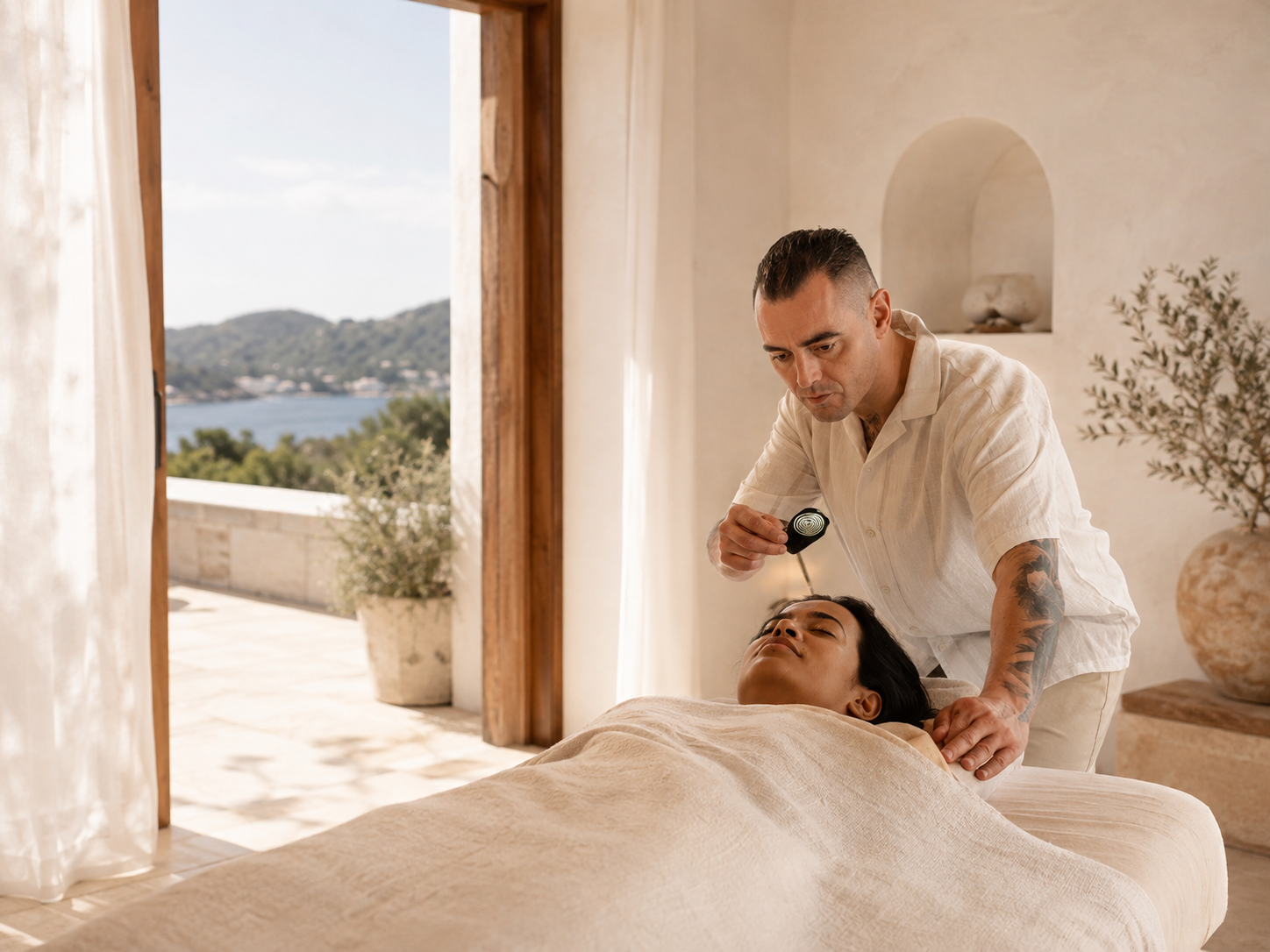
You lie fully clothed on a treatment table while the practitioner places their hands lightly on or just above a sequence of positions — head, shoulders, torso, knees, feet — holding each for several minutes. There is no massage, no manipulation and very little movement. The room is quiet, and most of the hour passes with almost nothing visibly happening.
What guests report is consistent even when their expectations are low: warmth or tingling under the hands, a heaviness in the limbs, a slowing of thought, and frequently sleep. We offer Reiki as a deep rest and stress-relief practice. Whether the mechanism is an energy transfer, as the tradition holds, or the well-documented effect of an hour of stillness and undemanding human presence, is a question we leave open rather than answer on your behalf.
A short history of the practice
Reiki was developed in Japan by Mikao Usui, a lay Buddhist practitioner, following a period of meditation and fasting on Mount Kurama near Kyoto in 1922. He founded a society in Tokyo that same year and taught a system combining hand positions, precepts and meditation. The word joins rei, meaning universal or spiritual, and ki, the life energy that also gives Chinese qi and Sanskrit prana.
Chujiro Hayashi, a former naval officer and one of Usui's students, systematised the hand positions into a clinical sequence. It was his student Hawayo Takata, a Japanese-American woman from Hawaii, who brought the practice west in the late 1930s after being treated in Tokyo. She trained twenty-two masters before her death in 1980, and every Western lineage traces back through them.
From the 1980s onwards it spread rapidly through the complementary therapy movement, and a number of hospitals in the United States and United Kingdom now offer it as comfort care alongside conventional treatment, particularly in oncology and palliative settings.
Where it is most widely practised
Japan remains its origin, though the practice there is quieter and more traditional than its Western form. The United States has the largest number of practitioners and the most institutional acceptance, with Reiki volunteer programmes running in a significant number of hospitals. The United Kingdom, Canada, Australia, Germany, Brazil and the Netherlands all have large practitioner communities.
Ibiza has an unusually dense holistic community for its size, and Reiki is one of the most commonly offered practices on the island. Here it is typically delivered privately in villas and fincas, often as part of a longer wellbeing programme rather than as a standalone appointment.
Who this work is for
People carrying stress they cannot put down are the main group: guests who arrive unable to stop working, those going through separation, bereavement or a difficult period, and anyone whose sleep has gone. It is frequently booked by people who have already tried massage and found that the physical release did not reach whatever is underneath.
It also suits anyone for whom hands-on bodywork is unsuitable or unwanted — after surgery, during illness, with acute pain, with skin conditions, or simply because being handled feels like too much. Nothing is required of you and nothing needs to be removed.
A significant number of guests book it out of curiosity, and we are entirely comfortable with sceptics. Practitioners here are used to people arriving unconvinced, and nobody will ask you to believe anything.
Who should speak to us first
There are very few physical contraindications, as nothing is manipulated. Do tell us if you would prefer no physical contact at all, in which case the practitioner works with hands above the body, and let us know about any recent surgery or injury so pressure and positioning are adapted.
We should be plain about what this is not. Reiki does not diagnose, treat or cure medical or psychiatric conditions, and no practitioner working with us will suggest that you alter or stop medical treatment. If you are in acute mental health difficulty, please seek clinical support; we may recommend Relaxation Massage or Meditation as gentler alternatives.
Reiki in Ibiza with The Luxurist
Sixty minutes, from €205, at your villa, hotel or yacht anywhere in Ibiza or Formentera. Your practitioner brings a treatment table, blankets and music, and asks only for a quiet room and an hour without interruption. Every practitioner is trained to master level, insured and vetted by us in person.
For something with more structure and physical release, see Sound Healing Ritual or Nervous System Reset.