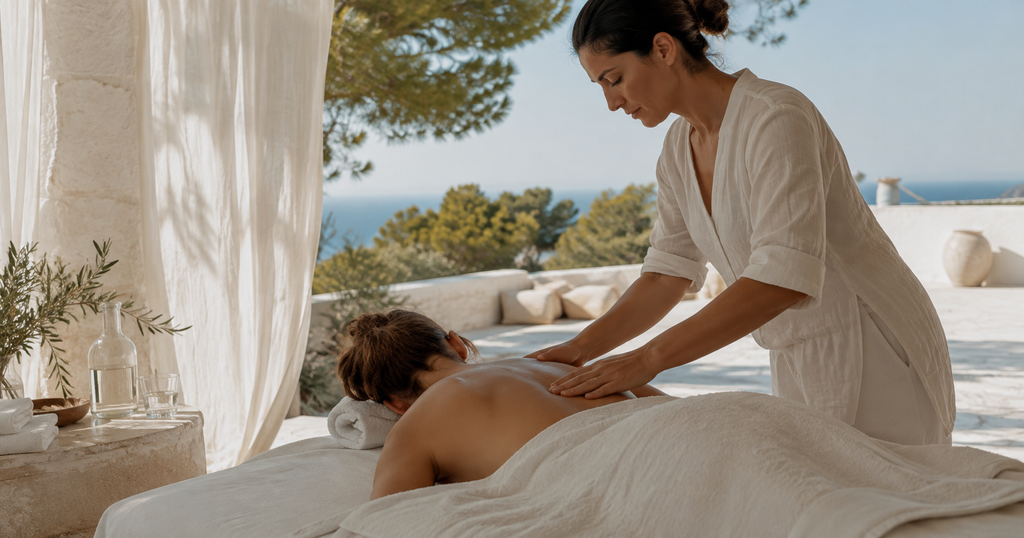
What relaxation massage actually is
Relaxation massage is deliberately unhurried. Long, light-to-medium strokes are repeated in a steady rhythm across the whole body, with no attempt to break down knots or work into problem areas. The therapist keeps contact almost continuously, warms the tissue with oil, and lets the pace do the work. Most guests stop tracking time within the first ten minutes and many fall asleep.
Where deep tissue asks something of you, this asks nothing. Its purpose is to move the body out of alertness and into recovery: slower breathing, lower heart rate, softer muscle tone. It is the most sedative treatment we offer and the one guests most often book twice in the same stay.
A short history of the practice
Its technical vocabulary comes from the same nineteenth-century European lineage as classical massage, by way of Per Henrik Ling in Stockholm and Johan Georg Mezger in the Netherlands. What distinguishes relaxation work is not the strokes but the intention behind them, and that came from somewhere else.
The spa tradition shaped it. European hydrotherapy resorts of the eighteenth and nineteenth centuries built entire regimens around rest and passive treatment, and the twentieth century added aromatherapy: René-Maurice Gattefossé's research into essential oils in the 1920s and Marguerite Maury's later work bringing them into cosmetic and massage practice. The result was a treatment designed around atmosphere, scent and pace rather than clinical outcome.
From the 1980s onwards the international hotel spa industry made this the default luxury massage, and the research that followed on touch, cortisol and parasympathetic activity gave a physiological explanation for something practitioners had understood for a century.
Where it is most widely practised
It is the signature offering of the global spa industry, most established in Thailand, Bali and the wider Asian resort circuit, across the Mediterranean, in the Gulf states, and throughout North American and European hotel spas. Wherever people travel specifically to rest, this is the treatment that dominates the menu.
Ibiza is a particularly natural home for it. The island runs on late nights and early sun, and a large share of our bookings are guests trying to recover the sleep the season has taken. Delivered privately at a villa or on a yacht, with no drive home afterwards, it works better here than in any spa room.
Who this work is for
It suits anyone who is depleted rather than injured. Guests running on short summer sleep, people arriving off long flights, parents of small children, and those who spend their working lives in a state of low-grade urgency all tend to get more from an hour of slow, uninterrupted contact than from targeted pressure.
It is also the right choice for anyone nervous about massage. There is no discomfort to tolerate, no conversation required, and nothing you need to know beforehand. We book it frequently for older guests, for people with low pain tolerance or sensitive skin, for those recovering from illness where deep work is unsuitable, and for anyone whose stress is showing up as poor sleep, jaw tension or shallow breathing.
Couples and friends often book it together in the evening as the closing point of a day rather than the start of one.
Very little rules this treatment out, as pressure is light by design. Where an alternative fits better we will suggest Pre-Natal Massage, Reflexology Massage or Lymphatic Drainage.
Relaxation Massage in Ibiza with The Luxurist
Sixty minutes, from €175, at your villa, hotel or yacht anywhere in Ibiza or Formentera. Your therapist brings a professional table, fresh linens, warm oils and music, and asks only about pressure preference and areas to avoid before beginning. Every practitioner is qualified, insured and vetted by us in person.
If you want the same calm with more structural benefit, see Swedish Massage; for something closer to nervous-system work, see Nervous System Reset.