What mat Pilates actually is
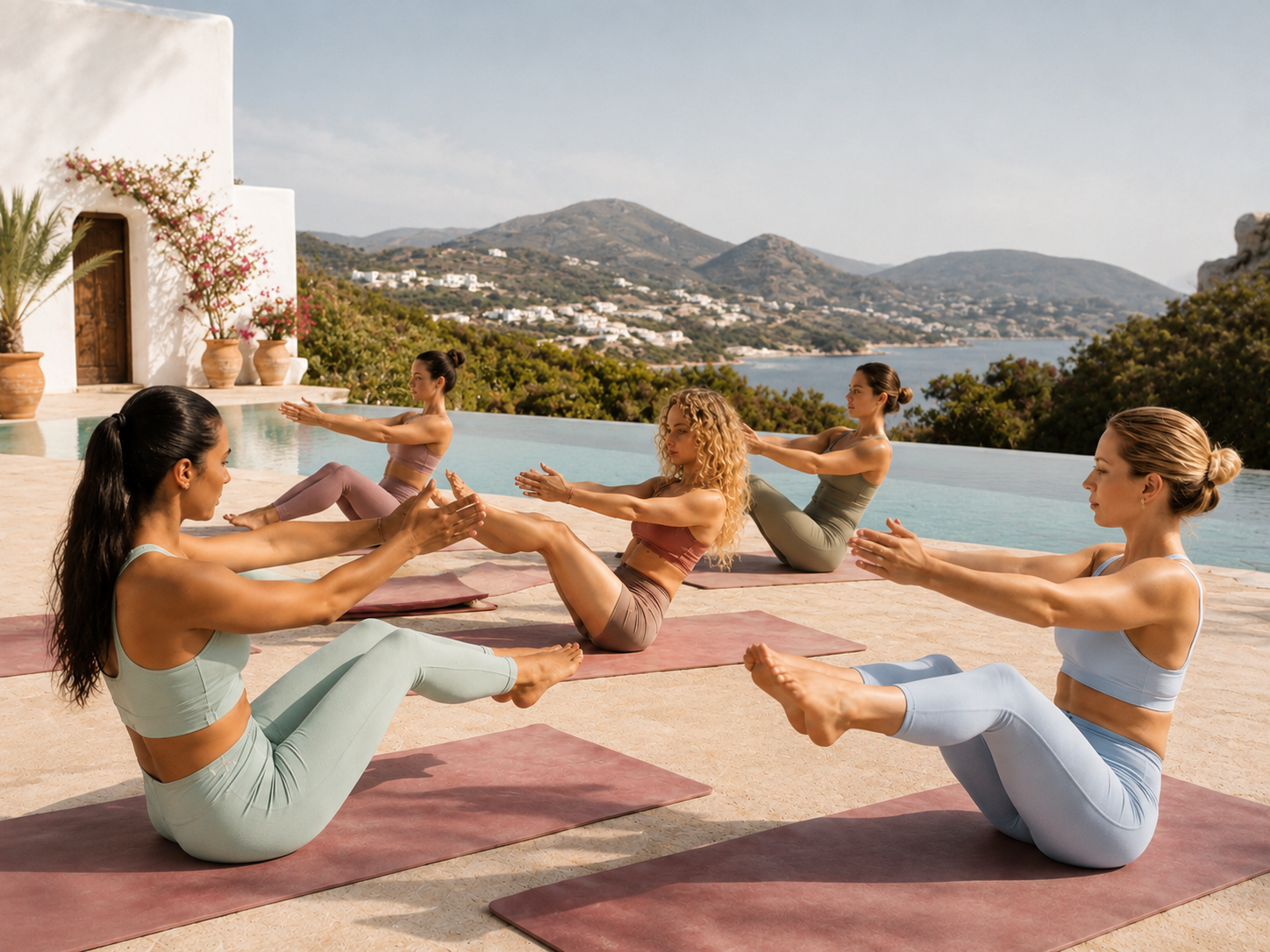
Mat Pilates is a precise, low-impact system of controlled movements performed on the floor, using your own bodyweight and small props rather than the spring-loaded machines found in a studio. The work concentrates on the deep stabilising muscles of the trunk, hips and shoulders, and on coordinating them with the breath.
Repetitions are few and slow. A set might be eight movements performed with complete attention rather than thirty performed briskly, and the difficulty comes from control rather than load. Done properly it is considerably harder than it looks, and the effect people notice first is not soreness but how they stand.
A short history of the method
Joseph Pilates was born near Düsseldorf in 1883 and built his method out of gymnastics, boxing, wrestling and self-defence. Interned on the Isle of Man as an enemy alien during the First World War, he taught exercise to fellow internees and began rigging bed springs to help bedridden patients move against resistance — the origin of the apparatus that became the reformer.
He emigrated to New York in 1926 and opened a studio on Eighth Avenue, in the same building as several dance companies. That accident of address shaped everything: the New York dance world adopted him, Martha Graham and George Balanchine sent dancers, and for fifty years the method was known mainly to performers. He called it Contrology.
A small group of students he trained directly, later called the elders, carried it forward after his death in 1967. It stayed niche until a 2000 United States court ruling found that Pilates was a generic exercise term rather than a trademark, after which the method spread worldwide within a decade.
Where it is most widely practised
The United States remains the largest market, with the United Kingdom, Australia, Germany, Brazil and South Korea all substantial. Australia is notable for how far Pilates has been integrated into physiotherapy and clinical rehabilitation, and Brazil for its scale in the aesthetic and studio market.
Mat work in particular travels better than apparatus work, which is why it dominates outside studio settings. In Ibiza it is one of the most requested villa classes, partly because it needs almost nothing — a flat surface, a mat, and an hour — and partly because it suits the mixed ability of a group of friends far better than a strong yoga or training session does.
Who this work is for
People with back pain form the largest group, and Pilates has a long association with lower-back rehabilitation through its emphasis on trunk stability and controlled range. Desk-based professionals book it for posture, and it is common among those who sit for a living and feel it in the neck and hip flexors.
It is also a staple for dancers, runners, cyclists, golfers and riders who need trunk control and rotational stability, and for anyone returning to exercise after injury or a long break, because load is minimal and progression is easy to manage.
Post-natal clients use it to rebuild abdominal and pelvic floor function with a suitably trained teacher, and older guests use it for balance, hip strength and the confidence that comes with both. It suits mixed groups better than almost anything else we offer.
Who should speak to us first
Tell us in advance about disc injuries or spinal conditions, osteoporosis, recent abdominal or pelvic surgery, hernias, joint hypermobility, pregnancy and how many weeks, or whether you are in the post-natal period and whether you have been checked for abdominal separation.
These change exercise selection rather than prevent participation: flexion is avoided in osteoporosis, certain abdominal work is modified post-natally, and hypermobile clients are taught to work within range rather than to it. Where a structured therapeutic approach is more appropriate, see Yoga Therapy or Osteopathy.
Mat Pilates in Ibiza with The Luxurist
Sixty minutes, from €175, at your villa, hotel or yacht anywhere in Ibiza or Formentera. Your teacher brings mats and small props — rings, bands, soft balls — and works on any flat, shaded surface. Every teacher is certified, insured and vetted by us in person.
For flowing movement rather than controlled repetition, see Private Yoga; for strength under load, see Personal Training.