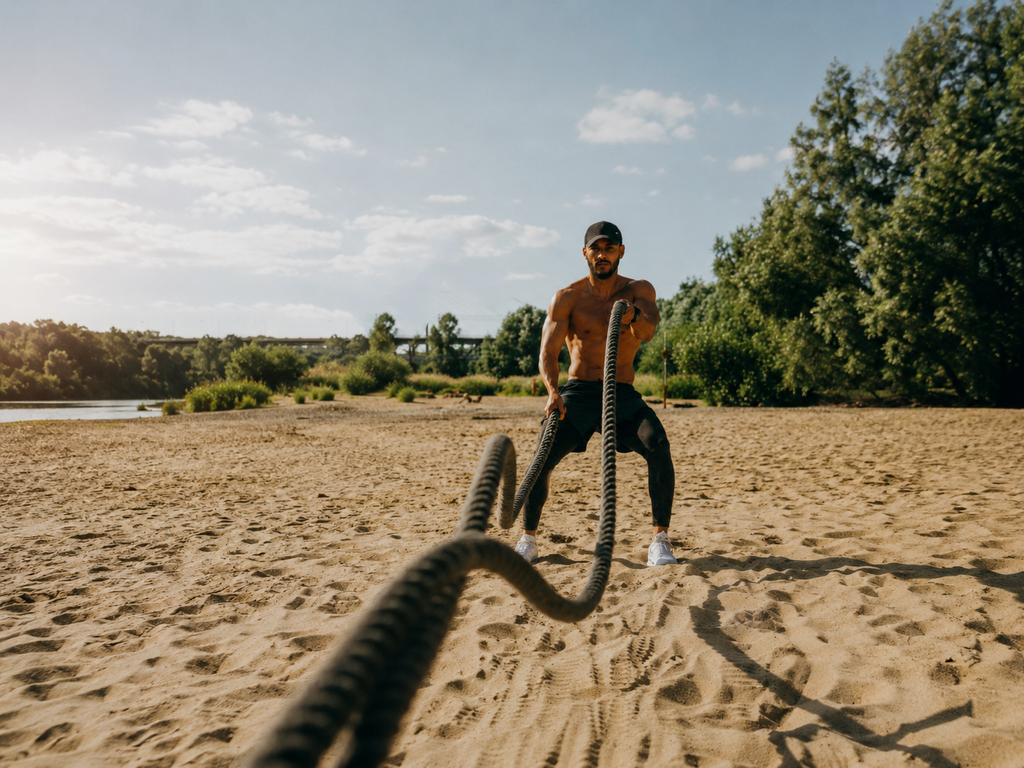
What a private training session actually is
A coach comes to you with the equipment your session needs and trains you in the space you have. Every session starts with a short movement screen and a conversation about what you have been doing, what hurts, and what you want from the week — then the programming is built from that rather than from a template.
The work itself depends entirely on your goal. That might be barbell-free strength using kettlebells, bands and bodyweight; conditioning intervals on a terrace; mobility and corrective work for a locked hip or shoulder; or maintaining a training block you have running at home so a week away does not cost you three months. What it is not is a generic circuit delivered identically to everyone.
A short history of the practice
Systematic physical training is old — the Greek gymnasia employed paidotribes who prescribed individual regimens, and Roman gladiator schools ran periodised programmes with specific diets. The modern lineage begins in nineteenth-century Europe with Friedrich Jahn's German gymnastics movement and Per Henrik Ling's Swedish system, both of which turned exercise into a structured discipline.
Personal training as a profession is much newer. Eugen Sandow, the Prussian strongman who toured at the turn of the twentieth century, was arguably the first celebrity trainer, and Jack LaLanne opened one of the first modern health clubs in 1936. The occupation proper emerged with the American fitness boom of the 1970s and 1980s, and the first certifying bodies — the NSCA in 1978 and ACE in 1985 — gave it professional standards.
The last two decades have changed the content more than the format. Strength and conditioning research, the functional movement screen, and the mobility work popularised by practitioners such as Kelly Starrett have moved personal training away from machine-based bodybuilding towards assessment, movement quality and load management.
Where it is most widely practised
The United States remains the largest market by a distance, followed by the United Kingdom, Australia, Canada, Germany and the Nordic countries, all of which have mature certification pathways and high gym membership. The Gulf states have grown quickly around private and in-residence training.
In-home and villa-based training specifically has become the norm in destinations where guests do not want to spend their holiday in a hotel basement gym. Ibiza is a clear example: villa terraces, gardens and pool decks are better training environments than most hotel gyms for eight months of the year, and the island has a substantial community of coaches who work almost entirely on location.
Who this work is for
People who already train are the largest group. They book to keep a programme running through a holiday, to avoid losing progress, or simply because training is how their week works. Coaches here are used to picking up an existing plan rather than replacing it.
Beginners are the second group, and private coaching is far and away the safest way to start: technique is built correctly from the first session and load is introduced at a sensible rate. Guests returning after injury or a long break use it for the same reason.
Beyond that, it is booked by people with a specific deadline — a wedding, an event, a season — by families training together, by couples at different levels, and by clients in their fifties and sixties for whom strength and balance are a longevity project rather than an aesthetic one.
Who should speak to us first
Tell us in advance about cardiac conditions, uncontrolled high blood pressure, recent surgery, disc or spinal injuries, joint replacements, diabetes, asthma, pregnancy, or any medication that affects heart rate or blood pressure.
None of these prevent training; they change the programme. Where a screen suggests something needs assessing before loading, your coach will say so rather than working around it, and may recommend Osteopathy or Yoga Therapy first.
Personal Training in Ibiza with The Luxurist
Sixty minutes, from €150, at your villa, hotel or yacht anywhere in Ibiza or Formentera. Your coach brings portable equipment — kettlebells, bands, suspension trainers and mats as required — and works with whatever the space allows, from a terrace to a beach to a private gym. You leave with session notes and a plan for the next one. Every coach is certified, insured and vetted by us in person.
For movement quality rather than load, see Animal Flow; for core and control, see Mat Pilates.