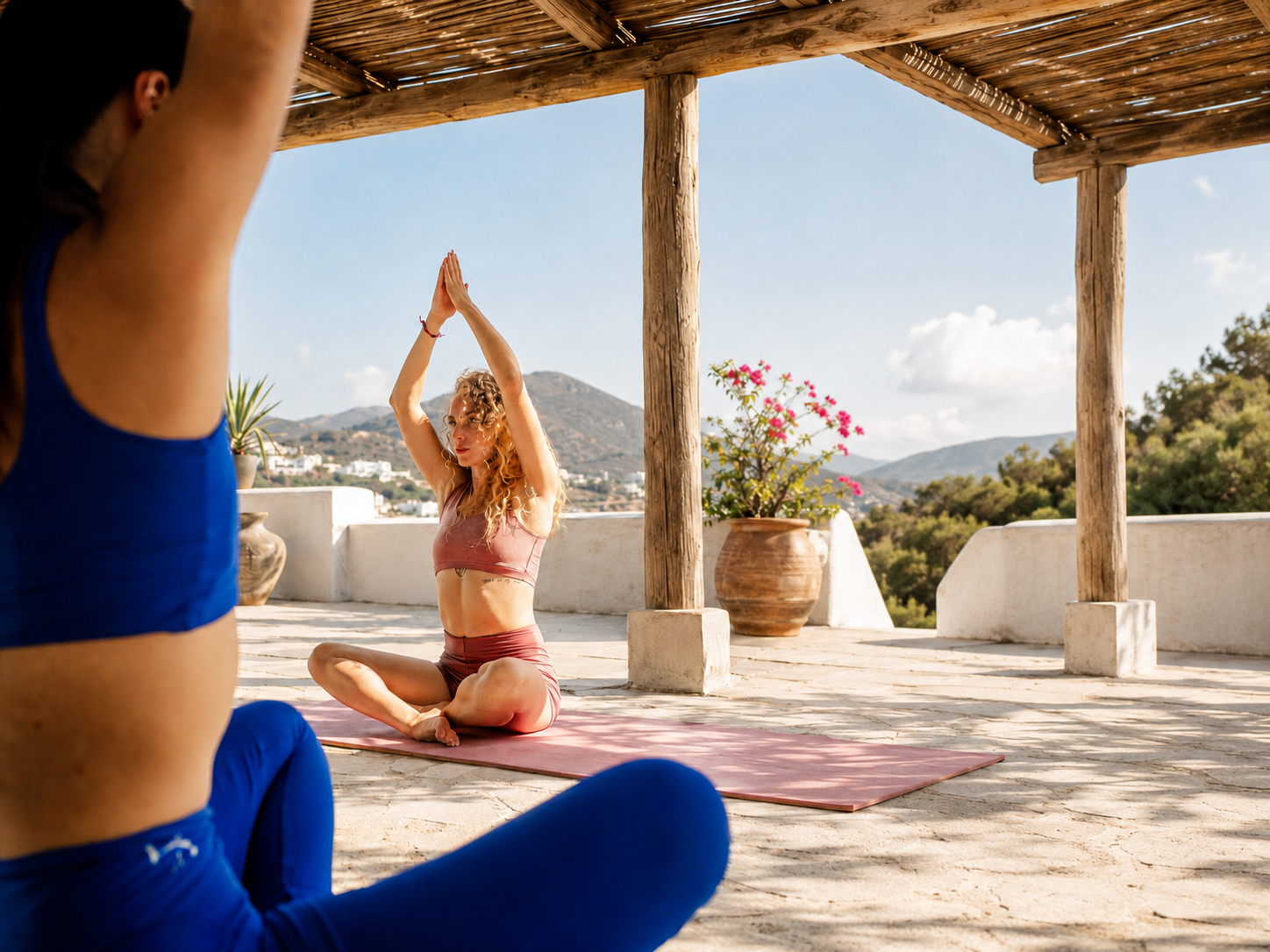
What a private yoga session actually is
A private class is not a studio class with fewer people in it. Because the teacher is working with one body rather than twenty, the session is built around what you can actually do: your hips, your shoulders, your injuries, your breath. Postures are adjusted rather than demonstrated, and you are given hands-on or verbal correction continuously instead of once a month.
Style is yours to choose. Vinyasa links movement to breath in a continuous flow; hatha holds postures longer with more attention to alignment; yin works passively into connective tissue with long holds; restorative uses props and does almost nothing at all. Tell us what you want from the hour — strength, mobility, calm, sleep, or simply moving after a long flight — and the teacher builds accordingly.
A short history of the practice
Yoga's textual roots run deep: references in the Upanishads from around 800 BCE, the Bhagavad Gita, and Patanjali's Yoga Sutras compiled roughly two thousand years ago, which set out an eight-limbed path in which physical posture is only one small part. For most of that history, yoga was a contemplative and philosophical discipline rather than an exercise practice.
The posture-based form most people now recognise is modern. Tirumalai Krishnamacharya, teaching in Mysore from the 1930s, synthesised traditional practice with Indian physical culture and Western gymnastics, and his students exported it: B. K. S. Iyengar built a precise alignment-based system with props, Pattabhi Jois formalised Ashtanga's fixed sequences, and T. K. V. Desikachar developed the individualised, therapeutic approach that underpins private teaching.
The West received it in waves — through Swami Vivekananda at the 1893 World's Parliament of Religions, through Indra Devi in Hollywood in the 1950s, through the counterculture of the 1960s, and through the fitness boom of the 1990s that produced vinyasa as we know it.
Where it is most widely practised
India remains the reference point, and Rishikesh and Mysore still draw teachers for training. The United States has the largest practising population, followed by Brazil, the United Kingdom, Germany, Canada and Australia, and Bali has become the dominant destination for teacher training worldwide.
Ibiza is one of the most yoga-dense islands in Europe, with a year-round teaching community and a long-established retreat scene concentrated in the north around Santa Gertrudis, San Juan and Benirràs. The character here is outdoor and unhurried, and the majority of practice happens on terraces, in gardens and on beaches rather than in studios.
Who this work is for
Complete beginners benefit most from private teaching, because the first weeks of yoga are where bad habits form and where most people quietly decide they are not flexible enough. One-to-one attention removes both problems.
Experienced practitioners book it to work on something specific: an inversion, a bind, a persistent shoulder restriction, or the difference between hip mobility and hypermobility. Athletes use it for range of motion and breath control. Guests with injuries or after surgery use it because a class cannot adapt around them.
Beyond that it suits families wanting to practise together at different levels, couples, groups on retreat, and people who simply want a calm start to a day that will not be calm.
Who should speak to us first
Tell us in advance about recent surgery, disc injuries or spinal conditions, uncontrolled high blood pressure, glaucoma or retinal problems, vertigo, joint hypermobility, osteoporosis, or if you are pregnant and how many weeks.
Almost nothing rules yoga out; it changes which postures are used. Inversions and deep backbends are avoided where appropriate, and props are used to bring the floor closer. For pregnancy, and for anyone working with a specific injury or condition, Yoga Therapy is usually the better booking.
Private Yoga in Ibiza with The Luxurist
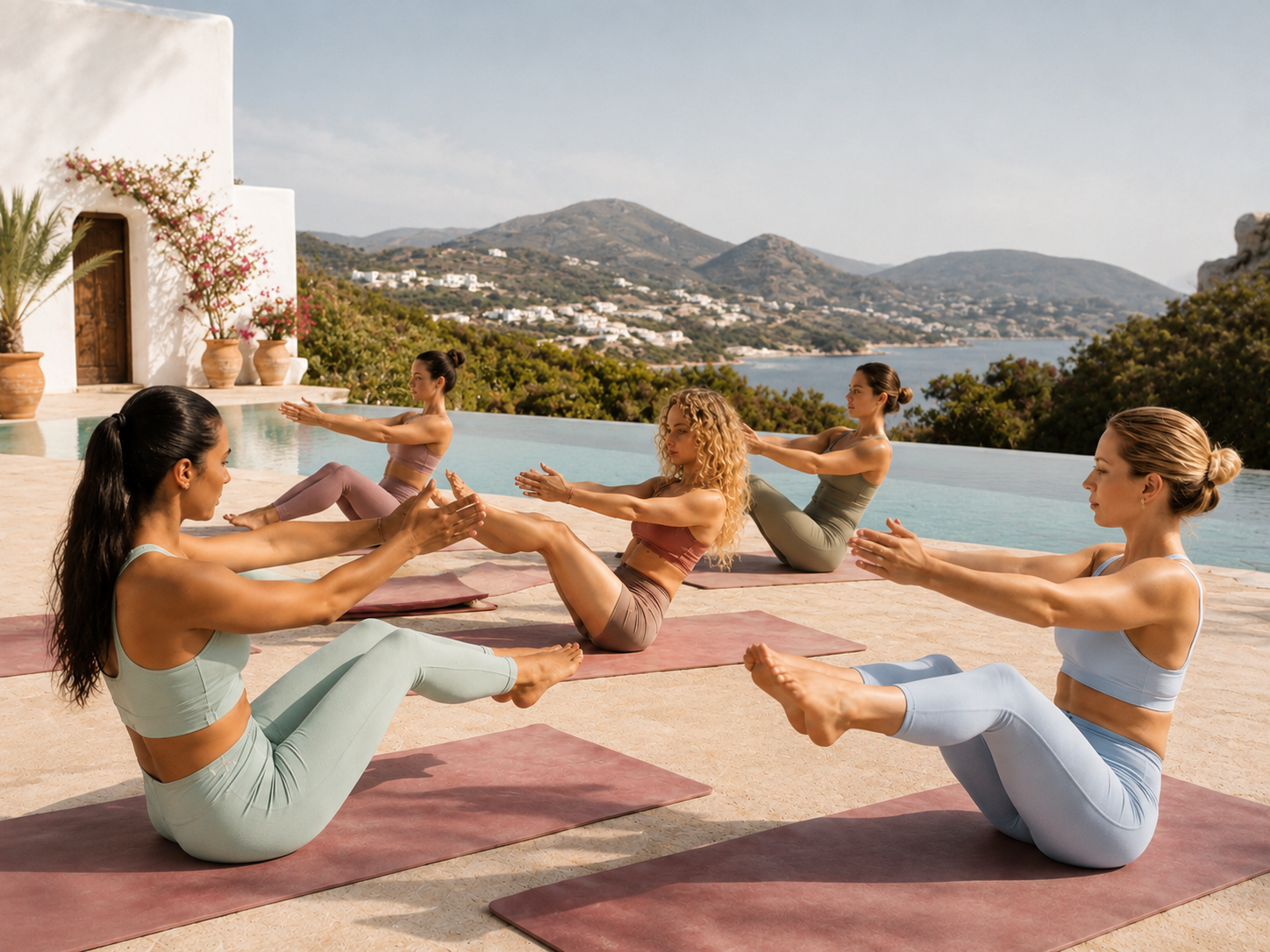
Sixty minutes, from €175, at your villa, hotel or yacht anywhere in Ibiza or Formentera. Your teacher brings mats, blocks, straps and bolsters, and adapts to the space you have, whether that is a terrace, a garden, a roof or a stretch of beach. Every teacher is certified, insured and vetted by us in person.
For something slower and more internal, see Somatic Yoga Flow; for strength alongside mobility, see Animal Flow or Mat Pilates.