What Animal Flow actually is
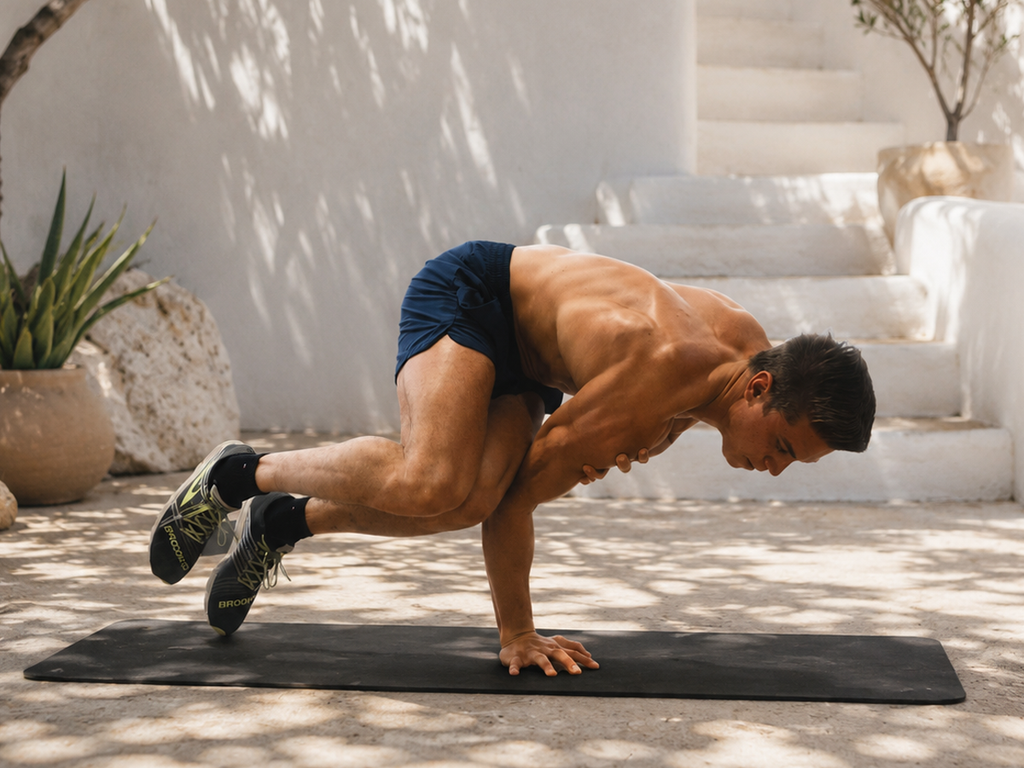
Animal Flow is a ground-based movement system practised entirely on your hands and feet, with no machines, weights or equipment involved. Quadrupedal positions borrowed from gymnastics, calisthenics, breakdance, capoeira and yoga are strung together into continuous sequences, so that strength, mobility, coordination and balance are trained in the same breath rather than in separate blocks.
The method is built from six components: wrist mobilisations, activations, form-specific stretches, travelling forms such as Beast, Crab and Ape, switches and transitions, and finally the flows themselves, where the movements are linked into an unbroken sequence. In a private session your coach dials the intensity up or down by changing the tempo and the transitions rather than by adding load, which is why the same practice suits a conditioned athlete and someone returning to movement after years at a desk.
A short history of the practice
The instinct behind it is old. Crawling, climbing and locomotion on all fours were formalised as training in the early twentieth century by the French naval officer Georges Hébert, whose Méthode Naturelle put natural human movement at the centre of physical education, and the idea resurfaced through the 2000s in the broader movement culture led by practitioners such as Erwan Le Corre and Ido Portal.
Animal Flow itself was created by the American fitness professional Mike Fitch around 2010 and released publicly in 2012. Fitch had spent years under heavy load and was carrying the joint wear to prove it; exploring bodyweight and hand-balancing work as a way back, he began combining gymnastic conditioning, calisthenics and dance-derived floor movement into repeatable sequences. What separated it from the wider movement scene was structure — a defined vocabulary, a coaching progression and a formal instructor certification.
That structure is why it travelled so quickly. Level 1 and Level 2 certification workshops have since been delivered in more than sixty countries, and Animal Flow has moved from a niche floor practice into standard programming in performance gyms, functional training studios and hotel fitness offerings worldwide.
Where it is most widely practised
The United States remains the home of the method, but Europe is now the strongest region by participation, and Spain in particular is one of its deepest markets — Spanish and Latin American coaches make up a significant share of certified instructors globally. The United Kingdom, Italy, Germany and Poland all have established communities, as do Brazil and Mexico, and there is fast growth across India, South Korea, Japan and Australia.
Beyond the studio, it has taken hold wherever training happens without equipment: beaches, rooftops, retreat centres and villa terraces. Ibiza suits it unusually well. The climate allows most of the year to be trained outdoors, the practice needs nothing more than a flat surface and a mat, and guests here tend to want a session that leaves them mobile and clear-headed rather than wrecked for the rest of the day.
Who this work is for
Animal Flow tends to attract people who have outgrown conventional gym training. Strength athletes, cyclists, runners, golfers and padel players use it to restore the ranges their sport quietly takes away, particularly through the shoulders, thoracic spine and hips. Surfers, skiers and sailors come for the rotational control and balance it builds.
It is equally chosen by professionals whose working life is spent seated, and who arrive on the island with stiff hips, locked-up shoulders and a body that no longer moves the way it used to. Dancers, yoga practitioners and Pilates regulars use it to add strength and load tolerance to mobility they already have, while clients in their forties, fifties and sixties book it as longevity work — joint capacity, wrist and shoulder resilience, and the confidence to get up and down off the floor without thinking about it.
It also travels well. Couples train it together at different intensities, families use it as something genuinely shared, and guests mid-recovery or between training blocks use it as intelligent conditioning that does not compound fatigue.
Who should speak to us first
The practice loads the wrists, shoulders and core heavily, and several positions bring the head below the heart. Tell us in advance if any of the following apply: acute or unresolved wrist, elbow or shoulder injury; recent surgery; pregnancy; uncontrolled high blood pressure; glaucoma or retinal conditions; vertigo or inner-ear disorders; or significant knee pathology.
None of these rules a session out on its own. They change how your coach builds it — elevated surfaces, fists or parallettes instead of flat palms, and transitions kept above heart height. Where a session is not the right call, we will point you towards a gentler ritual such as Somatic Yoga Flow, Yoga Therapy or a mobility-led Personal Training session instead.
Animal Flow in Ibiza with The Luxurist
Sixty minutes, from €175, at your villa, hotel or yacht anywhere in Ibiza or Formentera. Your coach begins with an individual movement screen, brings any portable equipment the session needs, and adapts to the space available, whether that is a terrace, a garden, a beach or a private gym. Every practitioner is certified, insured and vetted by us in person, and you leave with session notes and a progression plan so a second booking in the same week builds on the first rather than repeating it.
If you want to build a wider programme around it, Animal Flow pairs naturally with Personal Training, Mat Pilates and Yoga.