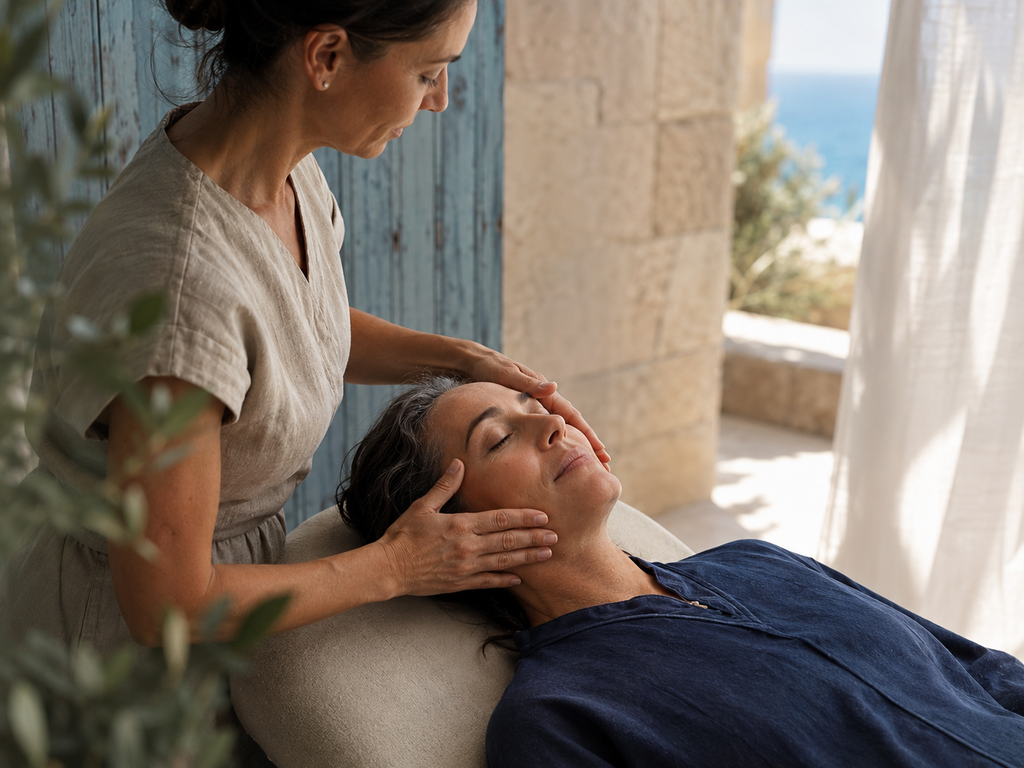
What facial massage actually is
Facial massage is manual work on the muscles, fascia and lymphatic vessels of the face, neck and décolletage. A session typically moves through cleansing, then lymphatic drainage along the jaw and neck to clear the drainage routes, then deeper sculpting and lifting strokes across the cheekbones, temples and brow, and finally release work on the jaw, the muscles at the temples and the base of the skull.
It is a treatment for how your face feels as much as how it looks. Most people hold a surprising amount of tension in the jaw and around the eyes, and unwinding that changes the face visibly within the hour: less puffiness, a cleaner jawline, softer expression lines. The results are real and temporary, which is exactly why guests book it the day of an event.
A short history of the practice
Several traditions converge in a modern session. Japan contributes Kobido, a lineage of facial massage dating to 1472 and originally reserved for the imperial court, built on rapid rhythmic strokes and pressure points. India contributes mukha abhyanga, the facial component of Ayurvedic oil massage, and marma point work. China contributes gua sha, the scraping of skin with a smooth stone along the contours of the face.
Europe added the clinical layer. Emil Vodder's manual lymphatic drainage, developed in Cannes in the 1930s, gave the face a proper anatomical map of where fluid moves and in what order, and French cosmetic practice built the modelling and pinching techniques still taught in facial training.
The recent boom is a different story again. Buccal massage, worked from inside the mouth on the muscles of the cheek and jaw, moved from Brazilian and French practice into international attention in the 2010s, and facial massage generally has grown alongside a visible shift towards non-invasive treatment.
Where it is most widely practised
Japan and Korea are the deepest markets, where facial massage is a routine part of skincare rather than an occasional luxury, and where Kobido and lifting protocols are formally taught. France maintains a strong cosmetic-massage tradition, and Brazil is the home of buccal work.
In the last decade London, New York and Los Angeles have built an entire industry around it, driven by facialists working with performers before appearances. In Spain and the Balearics it is largely a hotel and villa treatment, and on Ibiza it is most often booked the afternoon of a wedding, a shoot, a party or a dinner where photographs are involved.
Who this work is for
People who wake up puffy book it most, particularly in summer, where heat, salt, late nights and a few drinks show in the face before anywhere else. Jaw clenchers and grinders are the second group, and the release work around the masseter and temples often eases headaches as much as it changes appearance.
It is popular with guests preparing for something specific: brides and wedding guests, anyone being photographed, and people who want to look rested on an evening that follows a heavy week. It is also a common choice for those who have decided against injectables, or who want to maintain results between them, and for anyone whose work involves long hours at a screen with a tense face and neck.
Men book it more than they used to, generally for jaw and neck tension rather than for appearance.
Who should speak to us first
Tell us in advance about active acne, rosacea flares, eczema or dermatitis on the face, cold sores, recent sunburn, or any skin infection. Also tell us if you have had injectables, fillers, laser, microneedling, peels or facial surgery, and when.
Timing around aesthetic procedures matters: we generally wait two weeks after botulinum toxin and longer after fillers or resurfacing, and we follow your practitioner's guidance over our own. Where facial work is not appropriate we may suggest Lymphatic Drainage or Relaxation Massage instead. This is a wellbeing and cosmetic treatment and not a medical one.
Facial Massage in Ibiza with The Luxurist
Sixty minutes, from €175, at your villa, hotel or yacht anywhere in Ibiza or Formentera. Your therapist brings a professional table, linens, cleansers, oils and serums, and works face, neck, shoulders and décolletage. Every practitioner is qualified, insured and vetted by us in person.
For clinical treatments rather than manual work, see Advanced Facial Aesthetics.