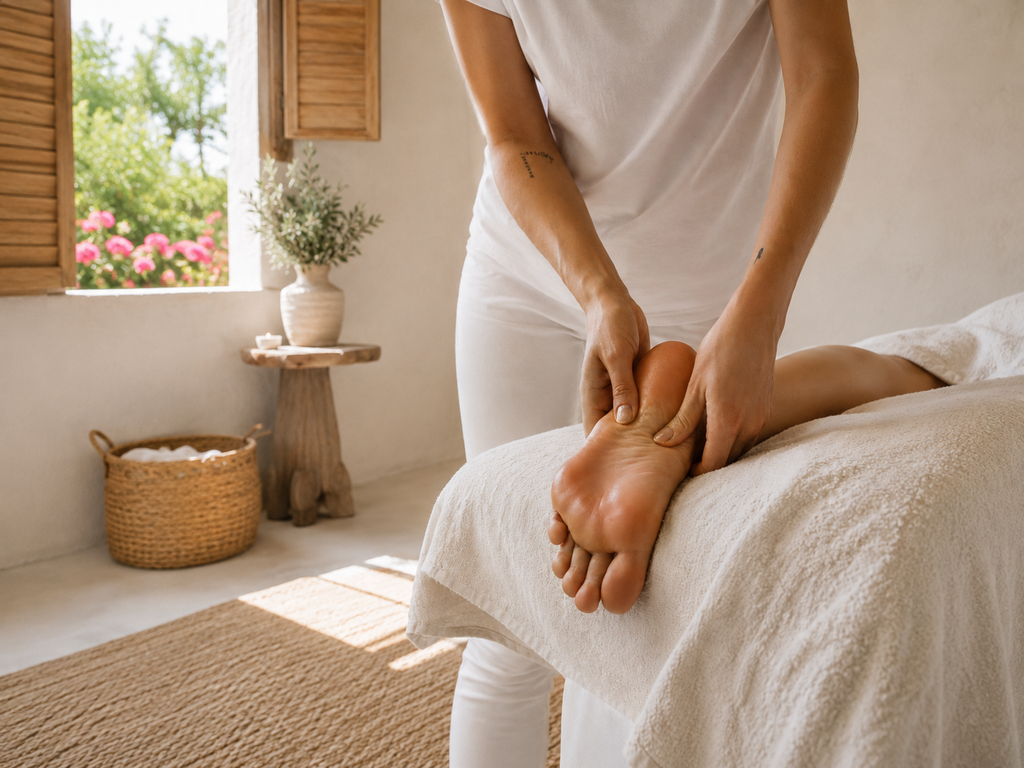
What reflexology actually is
Reflexology is detailed pressure work on the feet, and sometimes the hands and ears, using a walking motion of the thumb and fingers across mapped zones. The practitioner moves methodically over the whole foot rather than rubbing it, pausing on areas that feel congested or tender and returning to them. It is more precise and considerably more purposeful than a foot massage.
The traditional framework holds that regions of the feet correspond to areas of the body, so that the arch relates to the digestive area, the ball of the foot to the chest, and the toes to the head and neck. Whether or not you accept the map, the effect most guests report is consistent: profound relaxation, warmth through the body, and unusually good sleep afterwards. We describe it as a nervous-system treatment rather than a medical one.
A short history of the practice
Foot treatment appears in Egyptian tomb art from around 2300 BCE and has a long independent history in Chinese medicine, where foot pressure sits alongside acupuncture within the same understanding of channels and points. Similar practices are recorded among Indigenous peoples of North America.
The modern Western form dates from the early twentieth century. The American physician William Fitzgerald described what he called zone therapy in 1917, dividing the body into ten longitudinal zones running to the fingers and toes. His colleague Joe Shelby Riley refined the maps, and it was the physiotherapist Eunice Ingham who, through the 1930s, concentrated the work on the feet and produced the charts that reflexologists still recognise.
Ingham's nephew Dwight Byers carried the method internationally after the Second World War, and Britain became a particular stronghold from the 1960s onwards through the training schools that followed.
Where it is most widely practised
Denmark is the outlier: reflexology is the most used complementary therapy in the country and appears in workplace health schemes. The United Kingdom, Ireland, Germany and the Netherlands all have long-established professional associations, and it is offered in some hospice, maternity and oncology support settings as comfort care.
In Asia it never left. Foot reflexology is an everyday feature of life in China, Taiwan, Thailand and Singapore, generally firmer and brisker than the European style. In Spain and the Balearics it sits within the wider holistic scene, and on Ibiza it is most often booked by guests who want something restorative without undressing or being handled all over.
Who this work is for
It suits people who are wound up rather than injured. Poor sleep, racing thoughts, jaw and shoulder tension, digestive unease and the general depletion of a hard season are the reasons most guests book it, and the deep sedative effect is the reliable part.
It is also the sensible choice when full-body massage does not work for you: after surgery elsewhere on the body, during pregnancy with a suitably trained practitioner, for guests with sensitive skin or an aversion to being oiled, for those who prefer to stay clothed, and for anyone who simply finds massage tables uncomfortable.
Walkers, hikers and anyone who has spent a summer in unsuitable shoes book it for the feet themselves, which is a perfectly good reason on its own.
Who should speak to us first
Tell us in advance about pregnancy, deep vein thrombosis or a history of clots, foot injuries, fractures or recent foot surgery, gout during a flare, active infections, open wounds or fungal conditions on the feet, and diabetes with reduced sensation or circulation in the feet.
We should be clear about what this treatment is not: reflexology does not diagnose, treat or cure medical conditions, and we make no claims that it does. It is a relaxation and wellbeing practice, and it is not a substitute for medical care. Where it is unsuitable we may suggest Relaxation Massage or Reiki instead.
Reflexology in Ibiza with The Luxurist
Sixty minutes, from €175, at your villa, hotel or yacht anywhere in Ibiza or Formentera. You stay fully clothed apart from bare feet, seated in a reclining chair or lying on a treatment table, and your practitioner brings everything required. Every practitioner is qualified, insured and vetted by us in person.
For a broader calming ritual, see Sound Healing Ritual or Nervous System Reset.